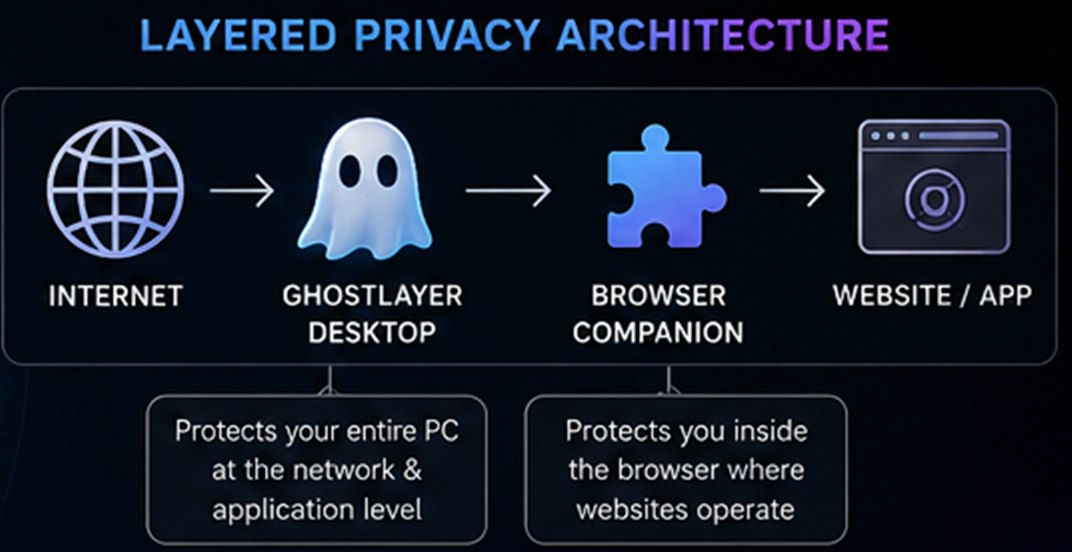
One request. Multiple defenses.
GhostLayer is envisioned as several protection layers working together, each responsible for a different part of the tracking problem.
An application makes a connection
Chrome, Firefox, Discord, Spotify, a game, or another program attempts to contact an internet destination.
Desktop checks the destination
GhostLayer compares the destination against local block rules, privacy categories, user rules, and optional DNS protections.
Allow or block
Known unwanted tracker or telemetry destinations can be blocked. Normal required traffic continues.
Browser companion handles the webpage
When installed, the extension can handle page-level protections such as URL cleanup, script-level tracker blocking, cookie controls, and fingerprint resistance.
Explain the result
The dashboard records a local, human-readable event: what tried to connect, which app initiated it, the category, and what GhostLayer did.
Block
Prevent a known tracker connection entirely.
Strip
Remove tracking metadata that is unnecessary for the destination.
Standardize
Prefer common values to reduce uniqueness where browser-level controls make this possible.
Spoof
Use synthetic values selectively where doing so improves privacy without creating a more unique fingerprint.
What happens server-side stays server-side.
GhostLayer can influence
- Whether a known external destination is contacted.
- Some browser-visible data exposed to webpage JavaScript.
- Tracking parameters in URLs.
- Some cookie and site-data behaviors.
- Local privacy rules and histories.
GhostLayer cannot simply rewrite
- A company’s existing server database.
- Everything inside every HTTPS connection without interception.
- Your public IP without a proxy/VPN-style network layer.
- Account information you deliberately provide to a service.
- Every possible future tracking technique.